Your Content Isn’t Failing. You’re Probably Measuring the Wrong Things.
Sometimes, I feel like defending the value of content to the C-Suite is an exhausting process.
Results must be instantaneous — every post should go viral, the phone should be ringing off the hook, website forms should be flooded with enquiries, and every dollar spent on marketing should quickly produce a measurable return.
The expectations can feel endless.
To be clear, it’s not unreasonable to expect marketing to contribute qualified leads and support business growth. I completely agree with that expectation.
But content marketing rarely works in a straight line.
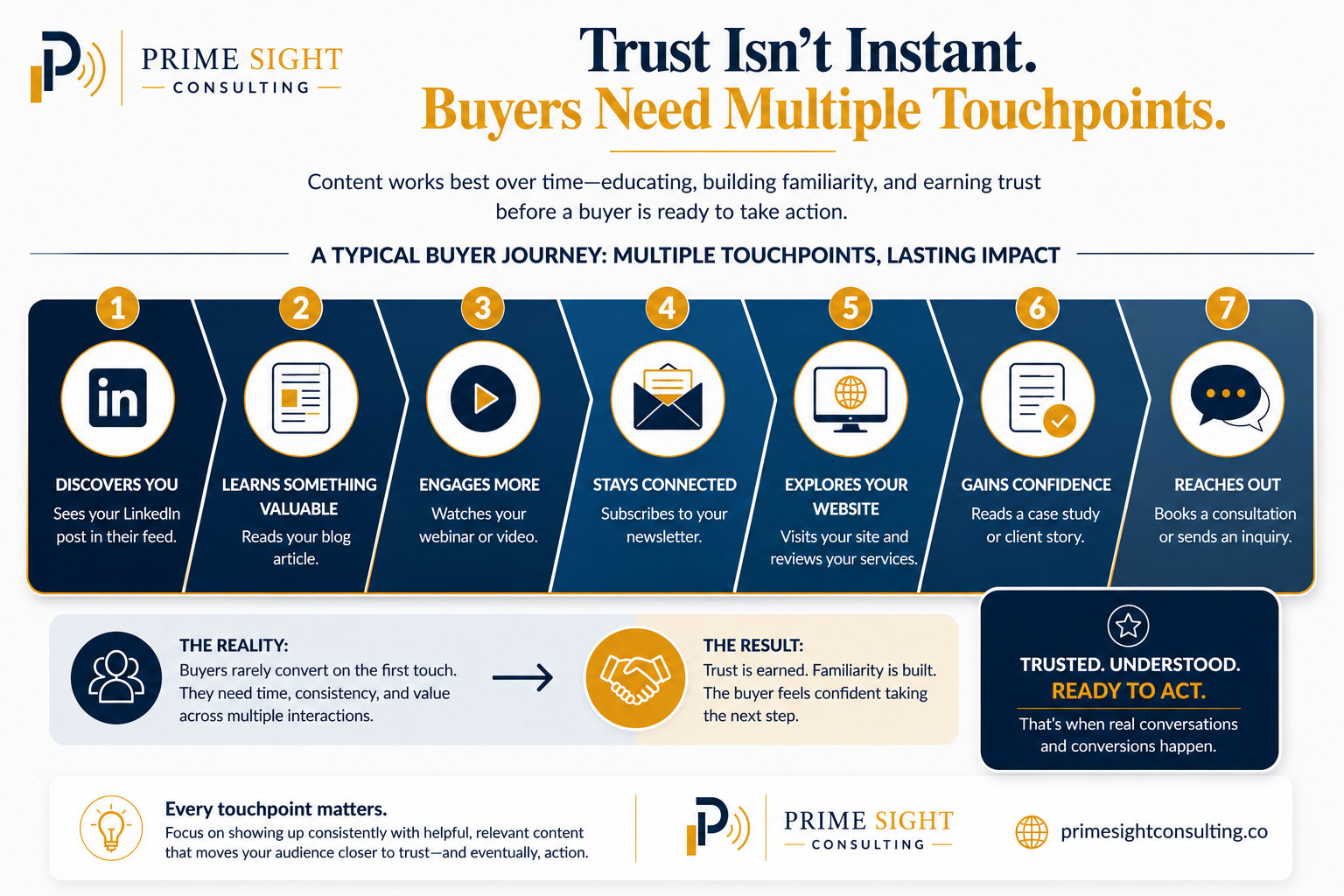
Buyers need multiple touchpoints before they begin to trust your brand. They need time to understand who you are, what you offer, and why your business is worth paying attention to.
I’ve experienced this tension firsthand.
A content initiative I believed in wholeheartedly was eventually scrapped because the CEO was no longer willing to invest in its production. No matter how much I explained the long-term value the initiative was creating — building authority, increasing audience knowledge, strengthening trust, and gradually nurturing a qualified pipeline — the results didn’t feel immediate enough.
At the same time, the company’s priorities were shifting, which made the initiative even harder to defend.
Experiences like this taught me something important:
If you want stakeholders to understand the value of content, you need data.
Not vanity metrics.
Not surface-level reporting.
You need meaningful data that helps connect content activity to business outcomes.
That’s why it’s so important to understand not only what to track, but also how to report it.
What Should You Track?
What you track should depend on the stage of awareness your content was created for.
You can’t evaluate awareness-stage content the same way you would evaluate content designed to convert prospects who are already highly aware of your brand.
For example, imagine you create a fun Instagram post featuring your team.
At first glance, the easiest metrics to track would probably be reach, impressions, likes, or shares.
But those metrics alone don’t necessarily tell you whether you reached the right people.
Instead, you could create a more intentional tracking process using an Instagram DM automation tool like ManyChat or SuperProfile.
Here’s how that could work:
Set up an automation that triggers a DM when someone comments a specific keyword on your post.
The automated message could ask the person to identify whether they fall within your target audience. If your ideal audience is new mothers, for example, the automation could ask whether they are a new mom.
Once they respond, you could invite them to follow your page and send them a free resource designed specifically for their needs.
What you’re really tracking here is not just engagement.
You’re tracking whether your content successfully reached the right audience.
That’s far more valuable than simply reporting impressions or reach.
Because while reach and impressions can provide visibility data, they don’t necessarily tell you whether you’re attracting the right audience.
A post can generate thousands of impressions and still fail to reach people who are genuinely likely to trust your brand, engage meaningfully, or become customers.
That’s why audience alignment matters so much.
Metrics like:
comments from ideal customers,
saves and shares from your intended audience,
DM conversations,
resource downloads,
profile visits from target segments,
or qualified enquiries
often provide far more meaningful insight into whether your content is resonating with the people you actually want to reach.
The chart below provides examples of the metrics you can track at each stage of awareness to demonstrate how content drives meaningful business results.

Visibility alone doesn’t confirm strategic alignment.
Being more deliberate about tracking the impact of your content provides a measurable way to evaluate whether your message is attracting the people you actually want to serve, even if they’re at the first two stages of awareness (unaware and least aware).
If you’re targeting prospects who are already highly aware of your brand, your tracking priorities should shift.
At that stage, you should be measuring conversions.
Questions like:
How many people subscribed?
How many enquiries came in?
How many qualified leads were generated?
How many people actually purchased your product or service?
These are the metrics that help connect content to revenue.
You also have to evaluate how your marketing ecosystem works together.
Not every social media post needs a DM automation.
But are you paying attention to:
what people are saying in the comments?
your blog bounce rates?
resource downloads?
your highest-performing pages?
the customer journey that leads to enquiries?
And most importantly:
Are you evaluating why certain content performs better than others?
Because those patterns often reveal what your audience actually cares about.
How Should You Report It?
When reporting on content marketing, focus on measurable outcomes.
Instead of simply saying:
“We reached 20,000 people.”
Go deeper.
Say:
We reached X number of people within our target audience.
We generated X qualified leads.
Prospects who engaged with our content entered sales conversations with stronger brand awareness.
Sales cycles shortened because buyers already understood our value proposition.
That context matters.
It helps stakeholders understand how content contributes to trust, positioning, lead quality, and long-term business growth.
It’s also important to set realistic expectations.
Strong content marketing usually compounds over time.
Reporting meaningful outcomes requires consistency, patience, and long-term tracking.
That’s why marketing teams need to communicate clearly about what success realistically looks like at different stages of the buyer journey.
Because not every valuable outcome happens immediately.
A Content Marketing Impact Report is a great way to give a high-level overview of the impact of your content marketing strategy.
Create a Content Marketing Impact Report
The image below shows an example of a Content Marketing Impact Report.

Notice that the metrics provided help build the case for strategic content creating measurable impact. There’s no fluff, just realistic figures that capture what truly matters to the C-Suite.
Your company may not have the budget to purchase a full-funnel analytics tool like DreamData or HockeyStack, or any enterprise-level platform that provides deep insights. So how can you get this data without feeling overwhelmed or burning out?
Start with this fact: you don’t need to track everything. I can hear you breathing a sigh of relief, and I totally get it. You’re creating a lot of content, and painstakingly tracking each content asset is impractical.
Instead, focus on tracking the signals that align most closely with your business goals.
For example:
If your goal is audience growth, track whether the right people are discovering your content.
If your goal is lead generation, focus on enquiries, consultations, downloads, or email sign-ups.
If your goal is trust-building, pay attention to engagement quality, returning visitors, and sales conversations influenced by content.
The objective isn’t perfect attribution. It’s building enough visibility into the customer journey to identify meaningful patterns.
Also, remember that every piece of content doesn’t directly contribute to a conversion. That’s rarely how a buyer’s journey works.
Someone may:
discover your business through a LinkedIn post,
visit your website weeks later,
read several blog articles,
watch a webinar,
subscribe to your email list,
and only then decide to book a consultation.
Which touchpoint deserves credit?
The reality is…all of them contributed.
That’s why it’s important to evaluate content as part of a larger ecosystem rather than expecting every asset to independently drive sales.
This evaluation depends heavily on how well you assess buyer journey signals, the indicators that content is influencing buying decisions.
Look for Buyer Journey Signals
Even without advanced attribution tools, you can still identify buyer journey signals.
For example:
prospects mentioning blog posts during consultations,
leads referencing LinkedIn content,
increases in direct website traffic,
repeat website visits,
longer sales conversations with more informed prospects,
or shorter sales cycles because buyers already understand your value proposition.
These signals matter.
They help tell the broader story of how content supports trust, education, positioning, and conversion over time.
Content Measurement Should Support Strategy — Not Create Burnout
The goal of reporting is not to create endless dashboards filled with disconnected metrics.
The goal is clarity.
You want enough information to:
understand what’s resonating,
identify what’s influencing business outcomes,
and make smarter strategic decisions moving forward.
Because good content measurement isn’t about proving that every post generated revenue.
It’s about understanding how content contributes to the buyer journey as a whole.
Great Content Marketing Starts with Clarity
Instead of getting all worked up about producing more content, take a deep breath and focus your energy on understanding whether your content strategy is aligned with the right audience, goals, and business outcomes.
Content works best when it is intentional, when it is rooted in clarity and when businesses understand how to measure the outcomes that actually matter.
Get the clarity you need. Book your Prime Sight Clarity Intensive.